
The Difference Between Spiritual Gifts and Spiritual Maturity
Jul 14, 2026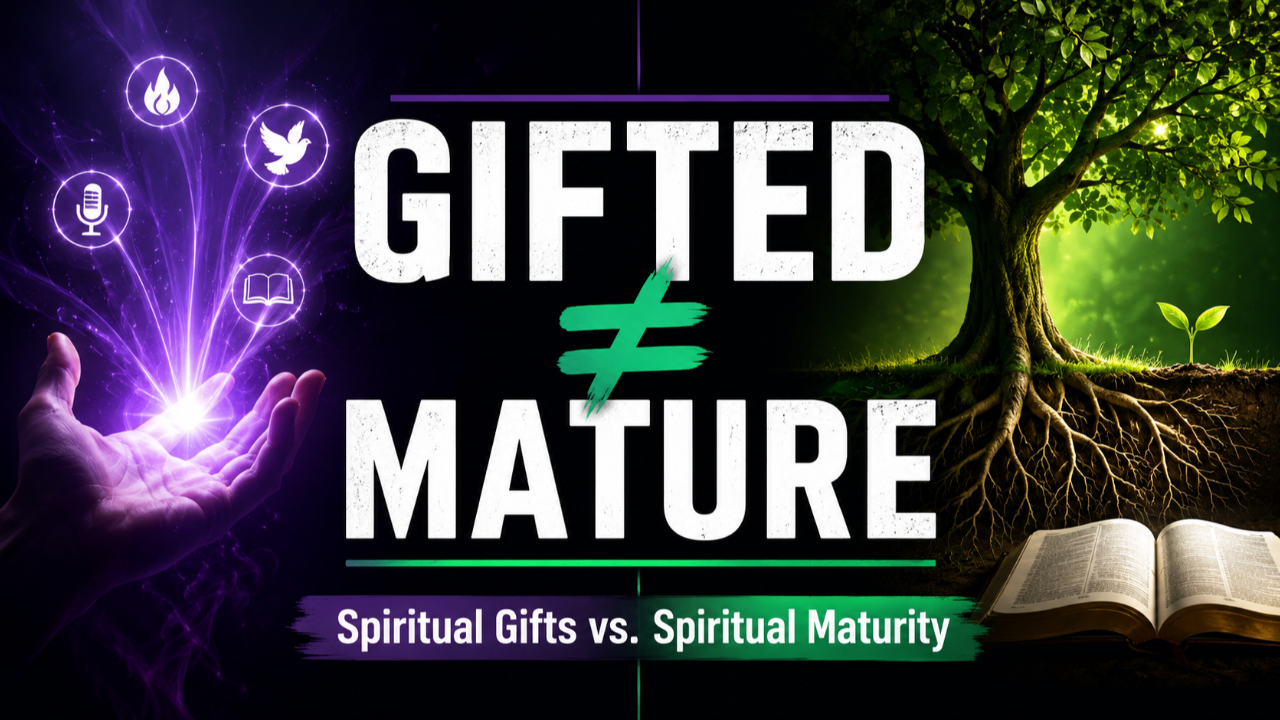
A person can be highly gifted and still be spiritually immature.
They may prophesy accurately, teach powerfully, discern spiritual activity, pray for healing, or receive vivid dreams and visions. People may admire their ministry and recognize the grace operating through their life. Yet none of those abilities automatically prove that the person has developed wisdom, discipline, humility, or Christlike character.
Spiritual gifts reveal what the Holy Spirit can release through a person. Spiritual maturity reveals what the Holy Spirit has formed within that person.
The two are connected, but they are not the same.
Confusing spiritual gifting with spiritual maturity is one of the reasons gifted believers are sometimes promoted before they are prepared. Their ability becomes visible before their character has been tested. Their public ministry grows faster than their private formation. Eventually, the weight of the gift exposes the areas of their lives that were never allowed to mature.
God does not only want to use your gift. He wants to form the person carrying it.
Spiritual Gifts Are Given
Spiritual gifts are expressions of grace distributed by the Holy Spirit.
Paul explains in 1 Corinthians 12 that there are different gifts, administrations, and operations, but the same Spirit works through them. These gifts are not rewards that believers earn after reaching a particular level of maturity. The Holy Spirit distributes them according to His will.
“But all these worketh that one and the selfsame Spirit, dividing to every man severally as he will.”
—1 Corinthians 12:11, KJV
A person may begin operating in a spiritual gift early in their Christian development. Someone may recognize that they are prophetic soon after coming to Christ. Another person may demonstrate unusual faith, discernment, teaching ability, or compassion before they fully understand how to steward that grace.
The gift may be genuine even when the person is still developing.
This is important because we should not dismiss every gift simply because the person carrying it is imperfect. At the same time, we should not assume that a genuine gift validates every decision, opinion, attitude, or behavior of the person operating in it.
The gift comes from God. The stewardship of that gift becomes the responsibility of the believer.
Spiritual Maturity Must Be Developed
Spiritual maturity is the result of formation.
It develops as a believer submits to Scripture, obeys the Holy Spirit, receives correction, endures testing, practices discipline, and allows the character of Christ to be formed within them.
Maturity is not measured by how long someone has attended church. It is not determined by a title, platform, vocabulary, or ministry position. A person can spend many years around spiritual activity without allowing that activity to transform them.
The writer of Hebrews addressed believers who had been around long enough to become teachers but had not matured in their understanding.
“For when for the time ye ought to be teachers, ye have need that one teach you again…”
—Hebrews 5:12, KJV
Time alone does not produce maturity. Growth requires participation.
A mature believer has learned to discern good from evil, govern their responses, submit their desires to God, and remain faithful when obedience is inconvenient. They do not merely know how to receive revelation. They are learning how to respond to revelation correctly.
The Corinthian Church Was Gifted but Immature
The church at Corinth provides one of the clearest biblical examples of the difference between spiritual gifts and spiritual maturity.
Paul told the Corinthians that they came behind in no spiritual gift.
“So that ye come behind in no gift; waiting for the coming of our Lord Jesus Christ.”
—1 Corinthians 1:7, KJV
This was a spiritually active church. Prophecy, tongues, interpretation, knowledge, and other manifestations were present among them. Yet only a few chapters later, Paul described the same believers as carnal and spiritually immature.
“And I, brethren, could not speak unto you as unto spiritual, but as unto carnal, even as unto babes in Christ.”
—1 Corinthians 3:1, KJV
Their gifts were operating, but their character was underdeveloped.
There was jealousy, competition, division, disorder, pride, and confusion among them. They were comparing leaders, forming factions, mishandling relationships, and using spiritual gifts without proper order.
Paul did not tell them that their gifts were false. He corrected the immaturity surrounding the use of those gifts.
This shows us that spiritual manifestation is not the same as spiritual formation.
A person can receive revelation from God and still respond to people from insecurity. They can discern what is happening spiritually and still lack wisdom concerning what to say publicly. They can carry a genuine gift and still compete for recognition, resist correction, or mishandle relationships.
The presence of a gift does not remove the need for discipleship.
Gifts Demonstrate Grace, Not Personal Superiority
Spiritual gifts are expressions of God’s generosity. They are not evidence that one believer is more valuable than another.
No one can take personal credit for a gift the Holy Spirit supplied.
The prophetic person did not create the ability to prophesy. The teacher did not manufacture the grace to teach. The person with discernment did not produce that spiritual sensitivity by human effort. Although gifts must be developed and practiced, their source remains God.
This understanding should produce humility.
When a person begins to believe that their gifting makes them spiritually superior, the gift becomes entangled with pride. They may begin demanding special treatment, refusing accountability, or interpreting correction as an attack against their calling.
Mature believers understand that being used by God is a privilege, not proof of personal greatness.
They can celebrate the gifts operating through others without feeling threatened. They do not need to be the most prophetic person in every room. They are not disturbed when someone else receives recognition. Their identity is rooted in Christ rather than public affirmation.
Spiritual Maturity Is Seen in Fruit
Jesus taught that people would be recognized by their fruit.
Fruit speaks to what a life consistently produces. It includes character, conduct, relationships, motives, and the effect a person has on others over time.
Paul describes the fruit of the Spirit as:
“Love, joy, peace, longsuffering, gentleness, goodness, faith, meekness, temperance.”
—Galatians 5:22–23, KJV
These qualities may not attract attention as quickly as prophecy, miracles, or revelation, but they reveal the condition of the inner person.
A gifted person may impress people during a ministry moment. A mature person can be trusted beyond the moment.
Maturity is revealed in how someone behaves when they are not being celebrated. It appears in how they handle disagreement, delay, disappointment, and correction. It is seen in whether they keep their word, honor boundaries, apologize sincerely, and remain faithful in ordinary responsibilities.
You do not measure maturity only by what comes out of a person while they are ministering. You also examine what consistently comes out of them when they are frustrated, overlooked, challenged, or inconvenienced.
Pressure does not create character. It exposes what has already been forming.
Mature Believers Know How to Govern Their Gifts
One of the clearest signs of spiritual maturity is self-government.
An immature person often feels compelled to release everything they receive. They may assume that because God revealed something, they must immediately say it. They have not yet learned that revelation, interpretation, application, timing, and delivery are separate responsibilities.
A mature prophetic person understands that receiving information does not automatically grant permission to speak.
They pray before responding. They consider the purpose of the revelation. They ask whether the word is meant for intercession, personal instruction, private counsel, or public declaration. They recognize that accuracy alone does not make a prophetic word appropriate.
Paul taught that the spirits of the prophets are subject to the prophets. The presence of spiritual inspiration does not remove personal responsibility.
Maturity teaches a person how to carry revelation without being controlled by the urgency to be heard.
This applies beyond prophetic ministry. Teachers must learn when and how to teach. Leaders must know when to speak and when to listen. Intercessors must understand that spiritual burden does not give them authority over everyone involved. Those with discernment must resist turning every perception into an accusation.
A gift that is not governed can injure the very people it was intended to serve.
Correction Reveals the Difference
Many people appear mature until someone corrects them.
Correction exposes whether a person’s identity is secure in Christ or dependent on always being perceived as right. It reveals whether they truly desire growth or merely desire agreement.
Immature gifted people often interpret correction as dishonor. They may defend themselves immediately, spiritualize their behavior, blame others, or use their gifting as evidence that God approves of them.
Mature believers understand that correction does not cancel calling.
They can examine what has been said without collapsing into shame or rising into pride. They ask honest questions. They take responsibility. They make adjustments when necessary.
They also understand that not every criticism is accurate. Spiritual maturity does not mean accepting every accusation. It means responding with wisdom rather than impulse.
A mature person can discern correction without becoming defensive, bitter, or rebellious.
Love Is the Governing Standard
First Corinthians 13 is often separated from Paul’s teaching about spiritual gifts, but it sits directly between chapters 12 and 14 for a reason.
Paul had been addressing a gifted but immature church. He wanted them to understand that spiritual power without love becomes empty noise.
“And though I have the gift of prophecy, and understand all mysteries, and all knowledge… and have not charity, I am nothing.”
—1 Corinthians 13:2, KJV
Paul did not say the prophecy was necessarily inaccurate. He said the person could operate in extraordinary spiritual ability and still lack the quality that gives the gift proper purpose.
Love governs how the gift is used.
Love does not manipulate people with revelation. Love does not embarrass people publicly to prove spiritual authority. Love does not use private information as a weapon. Love does not turn ministry into a performance designed to gain admiration.
Love asks what will genuinely serve the person receiving the ministry.
This does not mean mature ministry will never confront, correct, or challenge. Biblical love is not passive. It speaks truth, but it does so with the heart of God rather than the ego of the messenger.
Signs That Your Gift Is Growing Faster Than Your Maturity
It may be time to examine your formation when you are more interested in being recognized than being corrected.
You may be gifted but immature when you regularly speak before praying, resist accountability, compete with other gifted believers, or assume that spiritual revelation makes you the authority in every situation.
You may also need deeper formation when your public ministry is disciplined but your private life is consistently disordered. The goal is not perfection. Every believer is still growing. The concern is the refusal to acknowledge patterns that require attention.
Spiritual maturity begins with honesty.
Can you receive a “no” without becoming offended? Can you serve when your name is not announced? Can you hold a revelation without rushing to publish it? Can you admit when your interpretation was wrong? Can you honor leaders without losing your discernment? Can you celebrate someone whose gift appears stronger than yours?
These questions reveal more about maturity than public visibility ever will.
God Wants to Develop the Gift and the Person
You do not have to choose between spiritual power and spiritual maturity.
The goal is not to become so cautious that you bury your gift. Neither is the goal to pursue manifestations while neglecting character. God desires both expression and formation.
Your gift should grow.
Your discernment should become sharper. Your prophetic hearing should become clearer. Your teaching should become stronger. Your ability to serve others should become more effective.
At the same time, your patience should grow. Your motives should become cleaner. Your relationships should become healthier. Your response to correction should become wiser. Your love for people should become deeper.
Paul explained that ministry gifts were given for the perfecting of the saints until believers came into maturity and the measure of the stature of the fullness of Christ.
The goal of ministry is not simply more gifted people. It is the formation of people who increasingly resemble Christ.
Do Not Confuse Being Used With Being Approved
God can speak through imperfect people because every person He uses is imperfect. However, we should never use the fact that God has worked through us as permission to ignore what He is trying to correct within us.
A powerful ministry moment does not erase an unhealthy pattern.
An accurate prophetic word does not justify pride. A successful teaching does not excuse poor character. A growing platform does not prove that every private decision is pleasing to God.
The wise response to being used by God is gratitude and greater submission.
Rather than asking only, “How can I become more gifted?” begin asking, “Who am I becoming as I carry this gift?”
That question protects your calling.
Spiritual Maturity Makes Your Gift Safer
Your spiritual gift may open doors, but maturity determines what happens after the door opens.
Maturity helps you carry influence without becoming consumed by it. It teaches you how to minister without exploiting people, how to receive honor without demanding it, and how to remain accountable as your responsibility increases.
Your gift may cause people to listen to you. Your character will determine whether they can trust you.
Do not despise the season of formation because it feels slower than public ministry. God may be developing the internal strength required to sustain what you have been asking Him to release.
The delay may not be punishment. It may be preparation.
Allow the Holy Spirit to develop your gift, but also allow Him to confront your motives, heal your wounds, correct your patterns, and mature your responses.
The strongest spiritual life is not built on gifting alone.
It is built when grace, truth, character, wisdom, love, and spiritual power are allowed to grow together.
Continue Your Spiritual Growth
Spiritual maturity is not formed in isolation. Healthy community provides instruction, accountability, practice, and relationships that help you recognize areas you may not see on your own.
Join the free Ascenders Community for biblical teaching, spiritual growth conversations, and support as you continue developing your gifts and your life with God.