
What Is a Prophetic Scribe? The Biblical Role, Signs, and Stewardship of the Prophet’s Pen
Aug 01, 2026
By Nicola A. Maclin
A prophetic scribe is a Christian called to accurately record, preserve, organize, and communicate revelation or spiritual instruction for the benefit of others. Scripture does not identify “prophetic scribe” as a formal fivefold office, but it clearly shows prophets and scribes writing visions, preserving God’s words, teaching truth, and creating records that guided later generations.
A prophet’s journal is not a spiritual scrapbook.
It is a record of revelation, instruction, timing, response, and development. What appears to be a collection of unrelated dreams, prayer burdens, visions, Scriptures, and prophetic words may eventually reveal a much larger assignment.
Many prophetic people document revelation inconsistently. They write down the dream that frightened them but forget the quiet instruction they received during prayer. A prophetic word may be preserved without the date, context, people involved, or directions that accompanied it.
Months later, they are left with fragments.
Without an accurate record, it becomes difficult to determine whether God has been repeating Himself or whether a familiar subject has simply returned to mind. The modern prophet needs spiritual sensitivity, but sensitivity alone is not enough.
The prophet also needs a disciplined pen.
What Is a Prophetic Scribe?
A prophetic scribe is not simply a prophet who likes to write. The scribal function carries a responsibility to preserve what God reveals so it can be examined, tested, communicated, and acted upon.
Some prophetic scribes write books, teachings, prayers, songs, or prophetic words. Others build private archives, record dreams, document historical movements, organize revelation for leadership, or create resources that help people understand what God is saying.
Their work may remain private for years before it becomes public. Some of it may never be published at all.
The value of the work is not determined by how many people read it. Its value is found in whether the revelation was handled faithfully and served the purpose for which God gave it.
A prophetic scribe may help:
- Preserve the original language of a revelation
- Separate what was received from its interpretation
- Recognize connections across multiple encounters
- Organize spiritual instruction so others can understand it
- Track the development or fulfillment of prophetic words
- Turn revelation into teaching, intercession, preparation, or strategy
- Create a record that can serve another person or generation
The scribe does more than document an encounter. The scribe protects the integrity of the revelation as it moves from encounter to understanding and from understanding to responsible action.
Is the Prophetic Scribe Biblical?
The exact phrase “prophetic scribe” is not presented in Scripture as an official ministry office. The function, however, is clearly biblical.
This distinction matters.
Ephesians 4:11 identifies apostles, prophets, evangelists, pastors, and teachers. It does not add the prophetic scribe as a sixth fivefold office. We should not create a formal office where Scripture does not establish one.
At the same time, the Bible repeatedly shows God commanding prophets to write. It also shows trained scribes preserving, studying, and teaching sacred truth.
Matthew 13:52 says:
“Therefore every scribe which is instructed unto the kingdom of heaven is like unto a man that is an householder, which bringeth forth out of his treasure things new and old.”
Jesus presented a scribe who was instructed in the Kingdom as someone capable of bringing forth understanding from a carefully preserved treasury.
The modern term prophetic scribe describes a function in which prophetic revelation and scribal stewardship work together. It may operate through someone called to the office of the prophet, a person with a prophetic gift, or a Christian writer who carries a particular responsibility to document what God reveals.
The title should never be used to make ordinary writing sound more important. It should describe a genuine responsibility that can be recognized through biblical alignment, faithful practice, mature confirmation, and fruit.
Biblical Examples of Prophetic Scribal Work
Several passages help us understand the biblical foundation of prophetic writing and preservation.
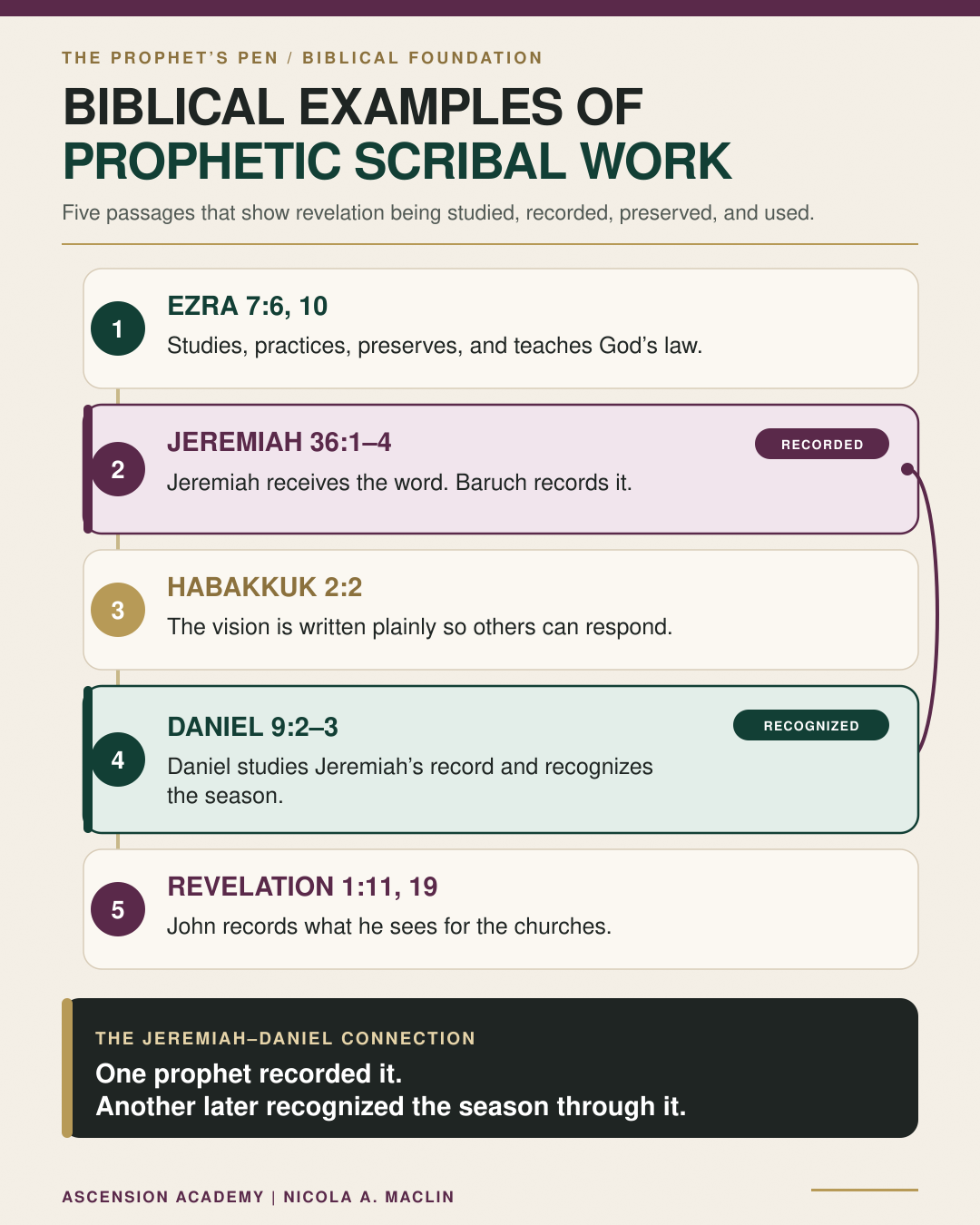
Ezra gives us a clear picture of the scribal responsibility to study, preserve, practice, and teach truth. Jeremiah, Habakkuk, Daniel, and John show how writing serves prophetic revelation.
These passages do not establish one rigid model. They show that God has repeatedly used written records to preserve revelation, direct people, awaken intercession, and carry truth beyond the original moment.
Prophetic Scribe Versus Christian Writer
A Christian writer and a prophetic scribe may both produce faith-based content, but the terms are not interchangeable.
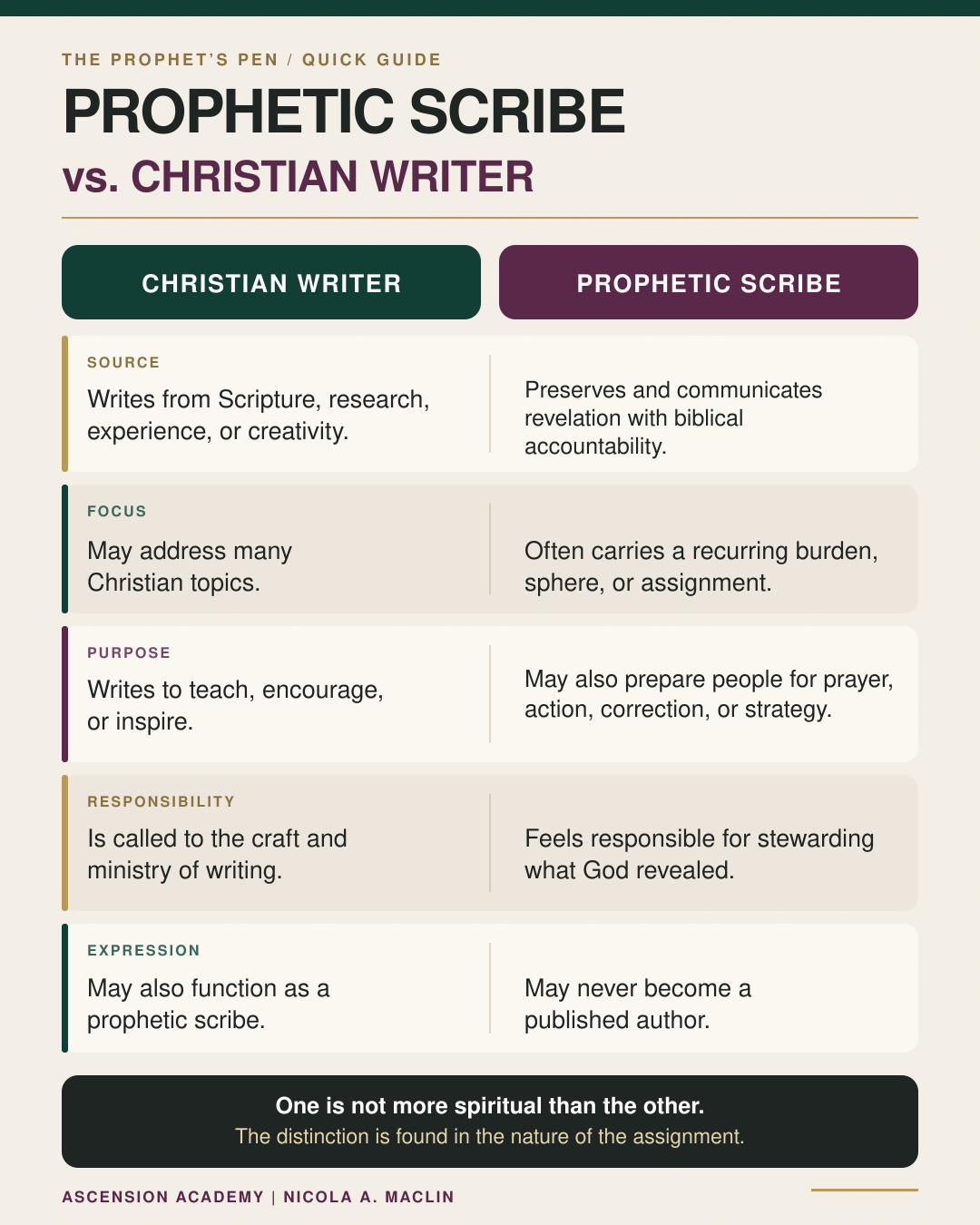
The difference is not writing talent. It is the nature of the responsibility.
5 Signs You May Carry a Prophetic Scribal Function
These signs are not a certification or a substitute for mature confirmation. They are indicators that may help you recognize how your prophetic gift operates.
1. You feel responsible for preserving what God reveals
You do not only want to remember the general idea. Exact language, timing, context, and details matter to you.
When something is not recorded, you feel that an important part of the encounter may be lost. This sense of responsibility often remains even when no one else will see what you have written.
2. You recognize relationships between separate revelations
A dream from several months ago may connect with a Scripture highlighted during prayer. Later, a prophetic word or ministry burden brings another part of the matter into view.
The prophetic scribe often notices these relationships through documentation. The connections are not forced together for dramatic effect. They become clearer through repeated review, prayer, and testing.
3. Writing helps you bring order to revelation
Some people receive understanding while speaking. Others begin to see the structure of a revelation when they write.
As you document an encounter, distinctions become clearer. You recognize what was directly revealed, what you assumed, what remains uncertain, and what requires further prayer.
Writing becomes part of the discernment process.
Prophetic scribes do not all receive revelation in the same way. Some document what they see or hear, while others preserve emotions, physical sensations, and changes in spiritual atmosphere. If revelation frequently registers through your feelings, read What Is a Prophetic Feeler? 9 Signs and How to Steward Spiritual Sensitivity to understand how this prophetic expression should be tested and documented.
4. Your record frequently serves people beyond you
What begins as a private journal entry may later become a teaching, warning, prayer directive, book, ministry resource, or strategy for leaders.
This does not mean every journal entry needs an audience. It means the fruit of your writing often carries instruction or understanding that can serve others when the timing is right.
5. Your writing moves people toward a responsible response
Prophetic scribal work should produce more than fascination.
It may call people to pray, prepare, repent, build, research, seek counsel, or return to Scripture. The writing gives language and structure to something people may have sensed but could not clearly identify.
Enjoying writing does not automatically make someone a prophetic scribe. Neither does keeping a dream journal. The function becomes more credible through consistent fruit, biblical soundness, humility, accuracy, and the ability to receive correction.
The Prophet’s Pen Is an Instrument of Stewardship
Habakkuk 2:2 says:
“Write the vision, and make it plain upon tables, that he may run that readeth it.”
Writing was part of the stewardship of the vision.
Habakkuk was not told to depend on emotional intensity to preserve what he had seen. The revelation needed to be made plain enough to survive the original encounter and guide the people responsible for responding to it.
Prophetic experiences can feel unforgettable when they happen. Time changes that. Details fade, hindsight affects interpretation, and people can unintentionally adjust what they remember to fit later events.
A written record protects the original revelation from those alterations.
It also gives the prophetic person something concrete to examine. The record can be compared with Scripture, reviewed with wise counsel, watched over time, and corrected when the first interpretation proves incomplete.
Writing does not make revelation more spiritual. It makes us more accountable for how we handle it.
Jeremiah Wrote What Daniel Would Later Need
The relationship between Jeremiah’s writings and Daniel’s intercession is one of the clearest examples of why prophetic documentation matters.
Jeremiah received revelation concerning Jerusalem’s desolation and the period of seventy years. That word was preserved in writing.
Years later, Daniel found himself living inside the conditions Jeremiah had described.
Daniel 9:2 says:
“I Daniel understood by books the number of the years, whereof the word of the LORD came to Jeremiah the prophet.”
Daniel received understanding through a prophetic record.
He did not read Jeremiah’s writing as interesting religious history. The preserved word helped him recognize the season his generation had entered. That understanding moved him into prayer, fasting, confession, and intercession.
Jeremiah’s revelation became part of Daniel’s strategic intelligence.
The pen of one prophet became the map of another.
This is the larger purpose of the prophetic scribe. A word may contain instructions for people who are not yet in position to act. A teaching may help a future generation recognize something God has already set in motion. A private record can preserve details that will only make sense once a later season arrives.
Prophetic scribes must learn to think beyond the immediate response to their work. Accurately preserved revelation can continue serving God’s purposes long after the original encounter has ended.
Recognizing Prophetic Patterns Without Manufacturing Them
Prophetic pattern recognition must be handled carefully.
Not every repetition is a message from God. The human mind naturally notices subjects it is already focused on. Social media algorithms can make a theme appear universal because similar content continues appearing in the feed.
Biblical prophetic discernment is not built by attaching spiritual meaning to every number, headline, celestial event, or coincidence. It begins with revelation from God, remains anchored in Scripture, and is tested over time.
A credible prophetic pattern usually develops through several forms of evidence:
- A subject returns across an extended period.
- Separate revelations contain related details without being forced together.
- Scripture provides a sound foundation for what is being discerned.
- Independent confirmation comes from trustworthy sources.
- Observable developments show progression, not merely resemblance.
- Mature counsel can examine the interpretation.
- The revelation produces a clear responsibility rather than spiritual fascination.
1 Thessalonians 5:20-21 says:
“Despise not prophesyings. Prove all things; hold fast that which is good.”
Testing is not unbelief. It is part of honoring revelation.
A mature prophet can acknowledge that a pattern appears to be developing while remaining honest about what is still unclear. That posture shows more prophetic strength than making an international announcement before the revelation has been properly tested.
Your journal gives you permission to watch something privately before speaking publicly.
What Documenting Heaven’s Patterns Actually Means
Documenting heaven’s patterns means tracing the recurring ways God draws attention to a responsibility, sphere, people group, institution, territory, or approaching season.
A prophet may begin having dreams related to leadership transitions. Over the following months, Scriptures about preparation and succession continue to surface. A prayer burden for leaders becomes more persistent, and separate ministry conversations return to the same subject.
No single experience should carry the entire interpretation. The documented sequence provides context.
As the record develops, the prophet may discover that the burden concerns one church rather than the entire Body of Christ. The assignment could involve privately supporting a leader, training emerging leaders, or interceding without making a public announcement.
Documentation helps reveal the boundaries of the revelation.
It also exposes premature conclusions. A series of dreams initially interpreted as a warning about leadership failure may eventually prove to be preparation for developing new leaders.
The pattern was real. The first interpretation needed correction.
The prophet’s pen must preserve the process, including the parts that reveal where our discernment was incomplete. A credible record is more valuable than a polished history designed to make the prophet appear consistently accurate.
What I Have Seen While Mentoring Prophets
In mentoring prophetic people, I have found that many scribes do not struggle to receive revelation. They struggle to build a system capable of preserving it.
Their dreams are in one notebook. Prophetic words are buried in voice notes. Instructions from prayer are mixed into everyday phone notes, while important Scriptures sit in screenshots that may never be reviewed again.
The problem is not always that God has stopped speaking. Sometimes the prophet has no reliable record of the conversation.
When revelation remains scattered, patterns are easily missed. Instructions are forgotten, and interpretations become disconnected from the original encounter. A person may keep asking God for another word while overlooking the assignment already forming across what He has said.
Professional prophetic practice requires a higher standard of stewardship. I am not talking about turning the gift into a commercial product. I am referring to discipline, accuracy, accountability, organization, and care.
If the revelation matters, the way we preserve it should reflect that.
How to Build a Practical Prophetic Ledger
You do not need an elaborate system. You need a record that you will use consistently and review honestly.
Each entry should include the following information.
1. Date and time received
Record the full date. Include the approximate time when several related experiences occur within a short period.
2. Type of revelation
Identify whether it was a dream, vision, impression, prayer burden, prophetic word, Scripture, inner knowing, or another form of revelation.
3. The raw record
Write what happened before adding your interpretation. Preserve exact phrases, people, emotions, actions, colors, locations, and unusual details.
4. Personal and ministry context
Note what was happening in your life, family, ministry, or assigned sphere when the revelation came. Context can affect both the source and the meaning of an experience.
5. Primary subject or sphere
Record who or what you currently believe the revelation concerns. Mark it as uncertain when the subject has not been established.
6. Related Scriptures
Include Scriptures that genuinely illuminate the revelation. Avoid searching for isolated verses merely to validate the meaning you prefer.
7. Initial interpretation
Explain what you currently believe the revelation means and why. Use language that reflects your actual level of certainty.
8. Required response
Identify whether the revelation calls for prayer, preparation, research, counsel, communication, repentance, practical action, or continued observation.
9. Confirmations and contradictions
Add information that later supports or challenges your interpretation. Both belong in an honest prophetic record.
10. Review and outcome
Return to the entry at scheduled intervals. Document later developments, corrections, partial fulfillment, completed fulfillment, or closure.
A simple status system can help you manage each entry:
- Unclear
- Under discernment
- Confirmed
- In progress
- Fulfilled
- Misinterpreted
- Closed
“Misinterpreted” belongs in the record.
Mature prophets do not rewrite history to protect their reputation. They study what they misunderstood and allow the experience to improve their discernment.
How Prophetic Scribes Turn Recorded Revelation Into Responsible Action
Revelation is not collected for fascination. At some point, what has been documented should help produce responsible stewardship.
A developing pattern may lead to:
- Sustained intercession
- Further biblical study or practical research
- Preparation within a family or ministry
- A private conversation with leadership
- Training people for an approaching need
- Building a teaching, resource, system, or institution
- Remaining silent until greater clarity comes
The pattern does not determine the strategy by itself. The prophet must continue seeking God concerning the appropriate response, timing, audience, and boundaries.
Early revelation is not permission to alarm people. It gives the prophet more time to pray, test the message, prepare wisely, and communicate with care.
Sometimes the correct response will be public instruction. Another situation may require private counsel. There are also revelations that should remain in the journal because the matter has not matured enough to be communicated responsibly.
The prophetic scribe does not only ask, “What did I receive?”
The next concern is stewardship: “What responsibility came with it?”
Return to What You Have Written
Before searching for another word, return to the revelation you already have.
Read through your dreams, prophetic words, prayer notes, visions, and highlighted Scriptures. Add dates where possible. Separate the original revelation from your interpretation, then begin grouping entries by subject or sphere.
You may discover that God has been speaking about the same assignment through several different encounters.
There may be a burden developing across the pages that you have not taken seriously. An instruction that once appeared isolated may be one part of a larger building mandate.
Your journal may already contain the beginning of the map.
Treat it with the care of a prophetic steward. Organize it, test it, pray through it, and watch how the revelation develops. Respond when God makes the strategy and timing clear.
Related Reading: How Do I know If I am Actually Called to the Prophetic
How to Grow in Your Prophetic Call
Frequently Asked Questions About Prophetic Scribes
What is a prophetic scribe?
A prophetic scribe is a Christian who carries a responsibility to accurately record, preserve, organize, and communicate revelation or spiritual instruction. The work may support teaching, intercession, leadership, preparation, or future generations.
Is prophetic scribe a biblical office?
Scripture does not identify the prophetic scribe as a separate fivefold ministry office. The function is biblical, however. Prophets were repeatedly commanded to write, and scribes preserved, studied, and taught sacred truth.
Is every prophet a prophetic scribe?
Many prophets should document what they receive, but not every prophet carries the same scribal emphasis. Some prophetic people have a distinct grace for preserving, organizing, and communicating revelation through written records.
What is the difference between a prophetic scribe and a Christian writer?
A Christian writer may create faith-based content through study, experience, research, or creative ability. A prophetic scribe carries a specific responsibility to preserve or communicate revelation. A person may function as both, but the terms do not mean the same thing.
What should a prophetic scribe record?
A prophetic scribe should record the original revelation, date, context, related Scriptures, initial interpretation, required response, later confirmations, contradictions, corrections, and eventual outcome.
Does journaling make someone a prophetic scribe?
No. Journaling is a valuable prophetic discipline, but the practice alone does not establish a scribal calling. The function should be recognized through consistent fruit, biblical soundness, faithful stewardship, and mature confirmation.
Put Your Prophet’s Pen to Work
If your dreams, prophetic words, visions, and prayer burdens are scattered across notebooks, voice notes, and your phone, it is time to create a more intentional record.
Prophetic Encounters: A Guided Journal to Record, Interpret, and Take Action on What God Is Revealing to You was designed to help you move beyond collecting revelation.
The guided process helps you document what you received, examine its possible meaning, identify the required response, and return later to record how the revelation developed.
Your journal may already contain pieces of an assignment that you have not recognized. Begin preserving those encounters with the care they deserve.
Purchase Prophetic Encounters on Amazon
For prophets who want deeper training, The Realm of the Prophets helps you grow beyond receiving revelation into discerning, documenting, communicating, and building responsibly from what God has revealed.
We are developing proficient prophets who know how to steward what God has already placed in their hands.
Nicola A. Maclin is a prophetic ministry teacher, author, mentor, and founder of Ascension Academy. Known as The Prophet’s Coach, she equips Christian prophets in prophetic discernment, dream interpretation, spiritual warfare, prophetic maturity, and the office of the prophet.